 By Catherine Walker, RPS Museum Officer
This South Asian Heritage Month we are taking a second look at some of the material in our RPS Museum, and their connections with Ayurveda.
Ayurveda is the knowledge of longevity, a system of medicine practiced in South Asia for centuries. It is a holistic approach to health and wellbeing, rather than simply treating an illness in isolation. Diet, exercise, and hygiene play an important role in the prevention, as well as the treatment, of disease.
The earliest Ayurvedic text dates to 100 AD and is known as the Charaka Samhita. Other texts were written in the 7th 8th and 14th centuries, and contributed to an understanding of the body, how to perform surgeries, and listed different medicines and how to use them.
In the Ayurvedic system, the body is made up of three Doshas: Vata, connected to air and space, Pitta, connected with fire and water, and Kapha, connected to earth and water. In addition to these doshas are seven bodily elements called Dhatu: lymph, blood, muscle, fat, bone, marrow, and semen. These humours and elements need to be actively kept in balance in order to stay healthy.
A number of medicinal plants important to Ayurvedic medicine feature in our RPS Museum collection. Look out for our Museum Monday posts for more details on some of these, such as guduchi (heart-leaved moonseed) and amla (Indian gooseberry).
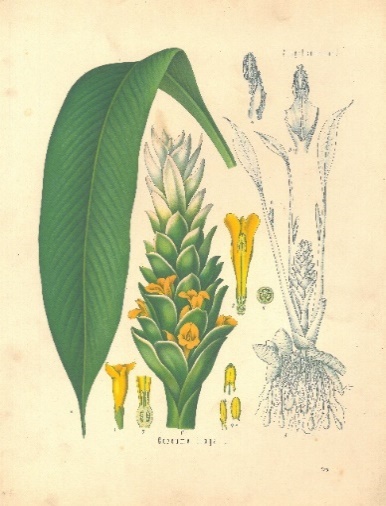
A medicinal plant that has importance in both Ayurvedic medicine and wider South Asian cultural practices is haridra (turmeric).
A bright yellow herb, haridra has been used in cooking and for dyes for millennia before the Ayurvedic texts were first written. In the Charaka Samhita, it was indicated as a medicine and incorporated into the Ayurvedic materia medica.
Within the Ayurvedic system, haridra is used for its dry, hot, pungent and bitter qualities, to reduce Kapha and to balance the Pittas. It is used for skin complaints, digestive problems, upper respiratory issues, and for arthritis and other joint complaints.
A tincture is made from the fresh rhizomes, which can then be combined with other ingredients depending on the element it is acting on. For example, the tincture is mixed with milk to ease digestion.
The active ingredient in Turmeric is curcumin, which has anti-inflammatory properties. It has been through a number of phase I clinical trials for its use as a cancer treatment, but randomised controlled clinical studies are still needed.
Register for our annual SAHM event.
Read more RPS blogs.